

Photo London Art Fair App
HS Projects, in collaboration with Festyvent, designed an App for Photo London as a useful resource during and post fair. The App was a two year project for Photo London held in Somerset House in 2016 and 2017.
In addition to addressing basic requirements of listing the exhibitors, programme, VIP, social media feed and buying tickets, the App helped visitors keep up to date during the fair with updated events and news, way finding within a complex fair geography, find other visitors, and exchange notes and images through social media and email.
The App enabled Photo London to see how visitors moved throughout Somerset House during the fair, identifying pinch points and low traffic areas enabling Photo London to respond in real time through direct messages to visitors.
Professionals attending Photo London 2016 and 2017 found the App content accurate and useful, especially as information was updated on a daily basis. The way finding section enabled them to plan their time more effectively.
Collectors liked the ability to plan their visit(s), book VIP programme events and talks through the App and re-evaluate their visit through the Favourites section.
Exhibitors liked the ability to notify visitors directly of in-fair special events, such as book signings, and the App’s flexibility to enable updates in real time during the fair.
90% of Photo London 2016 App users installed the Photo London 2017 App.
There was a 700% increase in downloads in 2017 over 2016.

‘Defined Change’, Shiraz Bayjoo
HS Projects commissioned ‘Defined Change’, a collaborative project between Shiraz Bayjoo and CRISIS. Six ex-homeless individuals were selected because of their success in reclaiming their lives, and because they presented a variety of habitats and spaces. The project aimed to explore their everyday living situations, how they act as metaphors for the past and suggest our anxieties for the future.
Working in collaboration with lead artist Shiraz Bayjoo, the participants explored key situations within their domestic lives, leading to a visual language that is expressive of both individual and collective experiences.
In analysing past traumas, the participants entered into a dialogue with Shiraz Bayjoo, discussing how present day living habits have come about, from the decorative and functional objects of the home to the interior domestic routines, such as making breakfast. This presented a voyeur like view of the habits one develops over time.
The project investigated hoarders who are compelled to catalogue every aspect of their existence, past and present. This contrasts with the entrenched rough sleepers who after a lifetime on the streets, and having finally come to terms with domestic living, reside in pristine, empty apartments, with modest acquisitions and taste.
Through the course of the discussions, the participants identified how these spaces and objects also came to signify the choices and changes they made to try to improve their situation. This was also explored in the activities and responsibilities they had chosen to take on in the outside world.
‘Defined Change’ was funded by the Insight Community Arts Programme (2002 – 2015).
The project ran from July to December 2009.
‘Tri Tin and other works’, Dan Rees
HS Projects presented an exhibition by Dan Rees of sculptural works, shown in the UK for the first time, that draw together various strands of his ongoing research into the use of seaweed as a food resource.
Rees’ work looks at the role of the Artist in today’s society and their potential as an instigator of social change. This installation focuses on seaweed, a commodity embraced by the East which remains a niche market in the West. Rees uses the idea of edible seaweed as a way to consider how the West must embrace new ideas in order to create a future where the sustainability of the planet and the needs of the population are valued above all else. The stark contrast of seaweed and aquaculture production in the East and West is due to many historic and geological factors, but the use of seaweed in Western diet dates back hundreds of years. Many of the advances in its cultivation were developed in the West, which suggests that the lack of farming in today’s society is largely down to negative cultural perceptions.
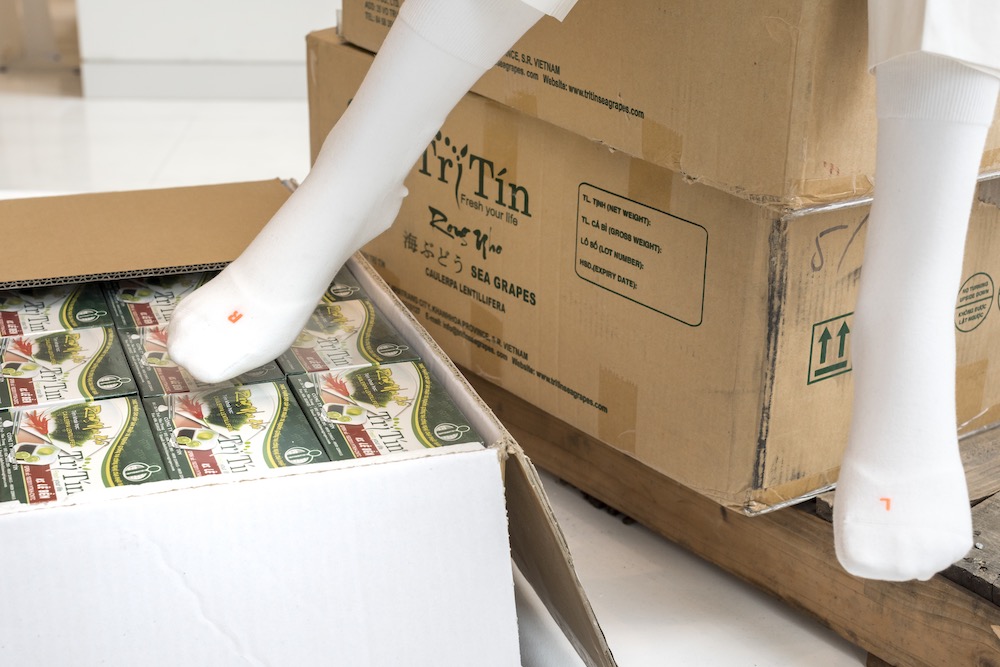
‘Tri Tin’, 2015 takes its name from a company in Vietnam distributing a type of seaweed known as Caulerpa lentilifera, commonly known as Seagrapes. The stack of eight Tri Tin boxes, containing 500 boxes of Seagrapes, represents the first large stock of the product that is known to be transported from Asia to Europe. If the slow growth in demand for edible seaweed within European markets continues, imports of products such as this will no doubt become common place. Tri Tin thus represents a product of the near future.
Dan Rees sees seaweed as the new superfood for the modern, young, stylish, metropolitan, health conscious consumer in ‘Untitled’, 2016, where a mannequin dressed in vintage Yves Saint Laurent clothes is positioned on top of Tri Tin.
‘Nha Trang’, 2015 a documentary video, mounted on a flat screen TV to the side of an IBC tank, internally lit with aquarium lights, depicts the workings of a small seaweed farm in Vietnam, a country where this type of aquaculture is mainstream, but has yet to establish itself on the international market. Rees has previously used IBC tanks (intermediate bulk containers) as mini domestic seaweed farms. The 1000 litre containers are easily purchased and transported and can be adapted as a form of small scale aquaculture farming.
Dan Rees’ research is positioned between posing a practical solution to pertinent questions concerning global food shortages and a utopian vision. The political aspect is found in the fact that seaweed is readily available for foraging in costal regions, is extremely nutrient rich and highly sustainable, requiring no land or fresh water to grow. Despite being eaten for centuries in parts of France, Ireland and Wales and its spreading appreciation, it has never become a mainstream food resource in the West, partially due to its perception as a poor person’s food, perhaps amplified by its use during the Irish Potato famine.
There is virtually no seaweed farming outside of Asia, although projects and initiatives are starting to be explored such as seaweed farming in Venezuela and Spirulina farming in Africa, its potential as a serious food alternative to wheat and corn remains largely unexplored. Harvesting and farming initiatives in this type of aquaculture helps diversify and localise food production, something that in poor countries becomes extremely important.
A blank Trivision billboard also features in the exhibition, a somewhat outmoded piece of technology no longer produced in Europe, with this model imported from China. ‘Trivision Billboard’, 2015, rotates on a timer, programmed to turn in a specific wave formation at various intervals, evoking both continuity and change. The work suggests the role of marketing and advertising in our daily lives and influencing the role of cybernetic feedback systems.
‘Tri Tin and other works’ was at 5 Howick Place from June to December 2016.