

‘Champagne Kid (Fallen) and other works’, Yinka Shonibare CBE (RA)
HS Projects presented an exhibition of some of Yinka Shonibare’s recent works, that continue the dialogue with his newly commissioned ‘Wind Sculpture’ for Howick Place, his focus on themes of colonialism, trade, and race, and his signature use of batik Dutch wax fabric designs.
‘Champagne Kid (Fallen)’, 2013 features a young boy caught in a moment of precarious exuberance and illicit celebration. On the floor with his legs in the air, the boy appears to have just toppled over his chair, while clutching a fizzing bottle of Cristal champagne. In the place of his head, one of Shonibare’s trademark globes illustrates the drastic losses in the stock and assets of Lehman Brothers, who declared bankruptcy in 2008. The sculpture calls to mind City whizz kids enjoying a moment of lavish excess, here literally knocked to the floor. With characteristic wit, this playful sculpture is a striking and yet subtle social commentary on our times. Combined with the carnivalesque pose of the animated figure, ‘Champagne Kid (Fallen)’ presents a powerful interpretation of our current state of affairs, as the innocent younger generation is set to inherit the excess of recent times.
In ‘B(w)anker (2)’, 2013 Shonibare presents a sharply suited rotund figure, with an exploding magnum of champagne. The cork explodes from the neck as fizz sprays out suggestively in a moment of raucous celebration. This portly gentleman presents himself as an upstanding member of society but is here caught off guard in a moment of debauched jubilation. The banker is tailored in a bespoke Victorian suit made in Shonibare’s signature wax batik fabric, the dress coat particularly highlighted with a bright explosive patterning. On closer inspection, the fobs on his gold chain include charms of golden nuggets and a ‘Veuve Clicquot’ bottle of champagne. The ‘B(w)anker (2)’ is a humorous reminder of a bygone era known for valuing class, money and indulgence: powerfully bringing to mind our own generation’s financial predicament. A commentary on the excess of the banking world, this work is a playful and provocative sculpture that is at once beautiful and bold.
The ‘Totem Paintings (1-5)’, 2011 combine African textiles with thick, impasto paint, bringing bright colours together with intense black. Tall and slender, their forms relate to the totems of the title. The nails that protrude from the edges of the canvas are a direct reference to African ‘minkisi’ figures made by the Kongo people of west-central Africa. These carved wooden objects were believed to have immense power, containing a spirit that was called upon to protect families or whole villages, to put right various wrongs such as crimes, and to exact vengeance and punishment. Hammering nails into the minkisi was intended to activate their spirits, with additional nails added every time the spirit was invoked. Minkisi were deemed sinister and threatening by colonial forces and were often seized – a symbolic gesture demonstrably removing power from the indigenous population. It was at this time that they became known as ‘fetish’ objects, emphasising the supposed strange savageness of the people who had made them. Many of the figures were brought back to England as curiosities. One of the ‘Totem Paintings’ has Dutch Wax fabric featuring UFOs, as though to emphasise further the perception of the minkisi and the cultures they hail from as alien. This is the first time this series has been shown together in London.
‘Champagne Kid (Fallen) and other works’ was at 5 Howick Place from April to September 2014.
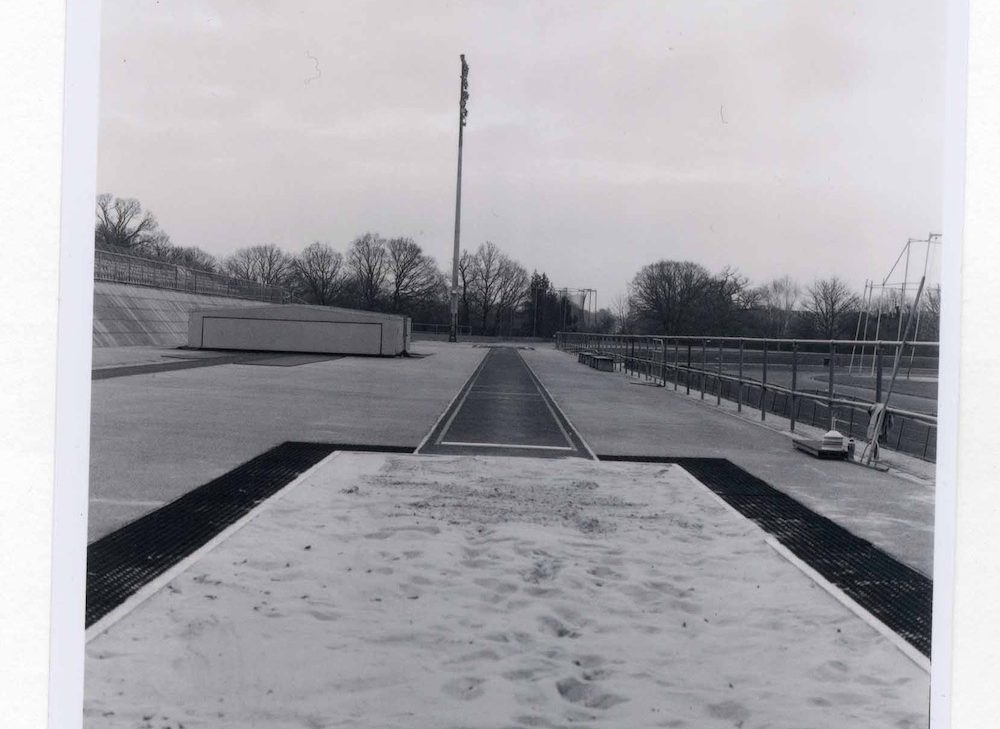
’14:30’, Faisal Abdu’Allah
HS Projects commissioned ’14:30′, a collaborative project between Faisal Abdu’Allah and the Pembury Estate Youth Club. The title of the project, ‘14.30’, was taken from the distance (14.3m) Nadia Williams (New Delhi Commonwealth Games Bronze medallist, 2010 and number 2 in England) had to jump to be included in Team GB for the 2012 Olympics and came about in discussion with the young people, who found Nadia’s challenge something they could relate and aspire to in the challenges they face.
‘14.30’ was a collaborative project whereby the content is shaped by the participants’ experiences, encouraging them to look at their own identity through the lens that focuses on an athlete preparing for London 2012, identity, home and the concept of community.
‘14.30’ was a project that chronicled two parallel journeys. Seven young participants from Pembury estate in Hackney were encouraged to look at their own identities through the lens of portraiture and social engagement. The broker that enabled them to map their cerebral thoughts was Nadia Williams. Nadia Williams took time from her Olympic qualification schedule to train the young people in the art of triple jumping. With this rare access, they witnessed, participated and soon realised their own ambitions could be achieved through determination and dedication.
Through a series of workshops, Faisal Abdu’Allah enabled them to assemble ideas, take portraits and place themselves at the core of their chosen works like a signature. Conscious of how society perceives ‘young guns’ from the Hackney estate, they clearly wanted this challenged. The final works were selected by a rigorous edit process that reflects the transition in the young people, as a result of their interaction with Williams.
The colour palette reflects the GB colours, each triptych is a metaphor for a Beginning, Middle and End, just like the Triple Jump. Screen printing the work by the young people at the London Print Studio, immediately changed their relationship to their work. More importantly it changed their perception of the process of making ‘Art’ for the rest of their lives. Knowing how to think, compose, scale, colour and physically print, really splintered their own understanding of how art is made. Opposed to clearly being of a generation that prints immediately via dry technologies.
’14:30′ was funded by the Insight Community Arts Programme (2002 – 2015).
The project ran from January to June 2012.

‘Sex and Friends’, Tobias Rehberger
HS Projects presented an exhibition of recent works by Tobias Rehberger. Rehberger draws inspiration from modernist art history, fashion, architecture, 1960’s and 1970’s design to create quirky and interactive objects, sculptures and environments, principally revolving around the concept of transformation. Rehberger is well known for his provocative ideas such as his proposal to refashion a Donald Judd sculpture into a bar and his questioning of authorship such as in sending basic sketches of luxury cars to a Thai car manufacturer who created inevitably imperfect versions of the vehicles based on the drawings. Working with industrial processes and technological innovations, and drawing on a repertoire of quotidian objects appropriated from everyday mass-culture, Rehberger translates, alters and expands ordinary situations and objects with which we are familiar.
‘Untitled (Sex)’, 2012 is a brightly coloured, abstract, quasi-anthropomorphic sculpture with retro, kitsch, Op like qualities. Depending on the ambient light, the work casts an eloquent word shadow on the floor, which reads ‘SEX’, accentuated by the sculptural configuration of its fleshy crests. The shadow word and its disappearance in space plays a kind of visual trickery on the beholder and acts as a good metaphor for transportation, for shifting from one place to another. As with all of Rehberger’s works, the viewer plays a vital role in the interpretation and meaning of the work and is invited to enter into a dialogue on perception, authorship and temporality.
‘Untitled (Anne Frank)’, 2011, which comprises of two works, is a brightly coloured, fluorescent sculpture and neon-environment machine, where the slick, glossy perfection of the manufactured is paired with the intentional imperfection of the crafted and the hand made. One work, Frank, composed of yellow, orange and transparent eclipses speckled with dots, creates an enjoyably kitsch, colourful, modulating abstraction, while the other work, Anne, is an upright of cubist wooden geometry which casts a shadow spelling the word ‘Anne’.
As with ‘Anne’, ‘Untitled (Never)’, 2011 is an upright of cubist wooden geometry which casts a shadow spelling the word ‘Never’. At first glance the sculptures seem abstract; they seem to question the functionality of an art object. Then, at regular but very brief times of the day, the amorphous shadows suddenly come together to form a previously hidden message.
‘Sex and Friends’ was at 5 Howick Place from May 2013 to March 2014.