
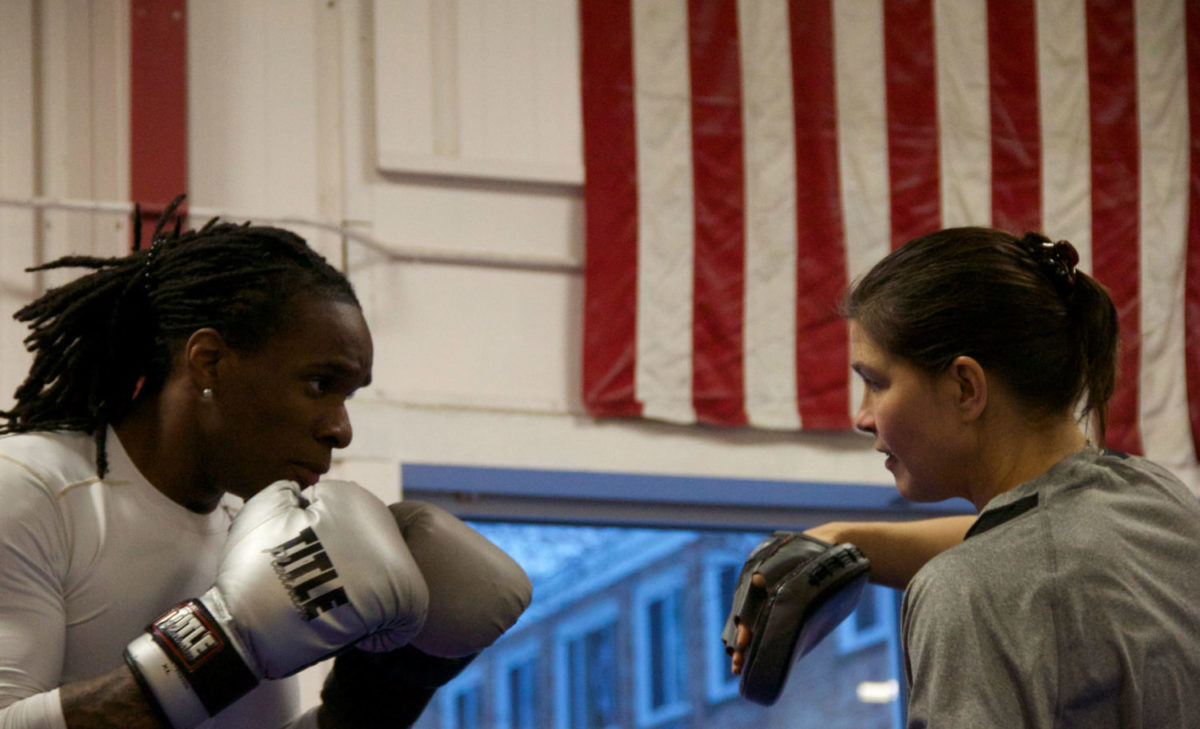
‘Box Clever USA’, Faisal Abdu’Allah
HS Projects commissioned ‘Box Clever USA’, a collaborative project between Faisal Abdu’Allah and Fords Gym, Madison Wisconsin that looks at the more philosophical side of pugilism. It separates the aggression, money and bravado that is commonly associated with the industry while capturing the solitude and serenity experienced by boxers. It offers an alternative mode of thinking and encourages young people to be an inspiration to their community; while also documenting the personal experiences of young people who are following the well trodden path of sport as a route to a better life.
During the course of the workshops, Faisal worked with young people who told very different stories about their approach to boxing through the camera lens in the confines of a corner of Fords Gym and in the middle of their workouts. At the heart of the project is Andrea Nelson, an ex-professional female fighter and Bob Lynch who coached two Olympic teams and managed the flyweight WBO Champion Eric Morrel, who have acted as mentors for the young people.
Dimarco, a Golden Glove winner from California who has a slim, wiry and lean figure and comes with incredible hand speed and precision, models his persona on Floyd Mayweather, but without the bravado. He is a man of few words and was intrigued by ‘Box Clever USA’, because he was able to see how human hands could be used in a different way, to create art.
Chris Ousley, ‘Golden Gloves’ AKA ‘Best in the Midwest’ is the prized asset of Fords Gym. Ousley exemplifies the essence of Box Clever USA, he demonstrates the difference between fighters and boxers. Ousley being the latter, quick, witty, stylish and technically flawless, he is full of creativity and beguilement. Ousley’s mind is always calculating the next move. Working to the concept of inside out, Ousley wanted the viewer to walk in his shoes and sense the decision making in those critical moments. He also took the photographs of participant Marcus Chancel, capturing the solitude and serenity experienced by boxers.
Marcus Chancel at the time was preparing to participate in the first round of the Golden Gloves 2015. In between the warm ups and bag work, he grabs the camera and emphasises key objects and symbols for him at Fords. The Ringside buzzer he photographs is the electronic time keeper and peace keeper, a small black box that beeps at three minute intervals.
‘Box Clever USA’ is a discourse in the arts of pugilism where the understanding of physics is paramount to have for balance and movement; a comprehension of music, for the rhythm and repetition of movements; an in-depth understanding of human biology to target human pressure points to beat your ‘live opponent’; and most importantly an awareness of space, to operate and make things happen.
‘Box Clever USA’ was partnered through the University of Wisconsin’s community outreach and engagement programme and funded by the Insight Community Arts Programme (2002 – 2015).
The project ran from June to December 2015.

‘Tokens’, John Aldus
HS Projects commissioned ‘Tokens’, 2006, a permanent public art commission on Marchmont Street, Bloomsbury by artist John Aldus. ‘Tokens’ evokes poignant memories of London’s great Foundling Hospital as well as the continuing worldwide themes of childhood abandonment, trafficking and exploitation.
We developed the project and artist brief, selection process including curating a public exhibition of the shortlsted artists’ concept proposals, established a stakeholder representative art committee and managed the commission from beginning to end.
Marchmont Street is built on land that was formerly part of the Foundling Estate, where stood the Foundling Hospital. This institution, Britain’s first home for abandoned children, was founded in 1739 by Captain Thomas Coram (1668-1751), a retired sea captain who, returning from North America was appalled to find so many poor and socially excluded children in eighteenth century London ‘left to die on dung hills’. His concern and determination led him to gather an influential set of governors, including William Hogarth and George Frideric Handel, and to obtain the royal patronage of King George II.
John Aldus took his inspiration from the poignant collection of tokens held by the Foundling Museum nearby. The tokens, left by mothers to identify their babies in case they came back to reclaim them once admitted into the Foundling Hospital, have since become poignant symbols of their hopes and dreams. Admission to the hospital was determined by a lottery-style draw of coloured balls from a sack. Drawing a white ball meant acceptance and a future for mother and baby, whereas drawing a black ball meant rejection; hence the expression ‘Black Balled’. The tokens included coins, scraps of ribbon and buttons.
Aldus worked closely with the Foundling Museum in translating his inspiration derived from these objects to create ‘Tokens’. Embedded into the very fabric of Marchmont Street, a trail of cast metal shapes, including the three different coloured balls, lie seemingly scattered on the pavement of Marchmont Street inviting the passersby to deeply engage with the tragedy of the time which still has resonances today. John Aldus’ ‘Tokens’ also marked the completion of ‘Marchmont Parade’, a new public space, which incorporates landscaping and public art.
‘Walking along a street, crossing a square is not a totally innocent act. Adventure, an encounter, the unexpected, a desire, an idea…… affect the senses of the walker, giving him as many approaches to the site that his mind is open to, that his curiosity allows’ – John Aldus.
‘The purpose of this work is to add to this process a dimension of time, inviting the viewer to ‘inscribe’ himself in the area’s history. Placing our steps in those of our predecessors, we find our place in this continuum becoming altogether witness of the past, actor of the present and a constitutive element of the ‘pasts to come’, of what our successors will be the observers and, in their turn, the actors. We are sharing a site across the time. In this perspective the viewer becomes the most important part of the art project: its subject’ – John Aldus.
‘Marchmont Parade’ was created by a unique public/private/community partnership, comprising the Marchmont Association, Allied London Properties, Hermes, Brunswick TRA and Camden Council. HS Projects commissioned ‘Tokens’ on behalf of the partnership.
‘Tokens’ is located on Marchmont Street, Bloomsbury, London.

‘What separates us’
HS Projects curated ‘What separates us’, a group exhibition by four Brazilian artists, Tonico Lemos Auad, Adriano Costa, Rodrigo Matheus and Matheus Rocha Pitta, funded by Arts Council England, at Sala Brasil, the Embassy of Brazil, London.
‘What separates us’ examines ideas of value systems and exchange mechanisms from cultural, social and economic perspectives. The exhibition explores ideas of international trade, travel and mobility, whilst examining the ‘real value’ of art and the system in which it is made and validated.
‘What separates us’ is located in the Sala Brasil, the former ticket hall for the Oceanic Steam Navigation Company, the Titanic ship operator, now home to the Embassy of Brazil in London. The works enter into a dialogue with the Sala Brasil’s historic ties with shipping and international trade, as well as how new emerging markets and decreasing trade restrictions have been instrumental to exchanges within the complex circuits of trade. The exhibition questions value systems, relationships with commodities, products and exchange mechanisms echoing transatlantic enterprises dating from the sixteenth century to current international interest in Brazil as a commercial partner. As part of this debate the exhibition examines the notion of art as a commodity, capable of being marketable, sellable and collectible.
Tonico Lemos Auad presents a sound installation, ‘Desafinado/Out of Tune’, 2003/2008, played on a three minutes and forty second loop which is being shown in the UK for the first time. Auad recorded a well-known blind Brazilian singer whistling the recognisable Brazilian ballad Desafinado by Joao Gilberto continuously for several hours. Auad observes the performer’s inhaling becoming demonstrably more demanding, selecting a point where the tune begins to break down. The resulting sound is melodious and melancholic and immediately familiar to any Brazilian, but the pauses charge the empty spaces with a distinct longing. The artist was interested in mapping this emptiness through this work, although now the work has also become a reflective commentary on the current socio- economic situation in Brazil.
Adriano Costa is re-configuring ‘New Contemporaries / Novos Contemporâneos’, 2015, an installation first shown at the Modern Institute in Glasgow, in which he makes a humorous play on the commodification and distortion of indigenous cultural meaning. Ayahuasca, a hallucinogenic decoction of ritual and sacred value to various native people in the Amazon, has become popularised as a pseudo-spiritual, recreational drug. Costa’s installation of white cotton t-shirts, for sale at £10 each, in a variety of fonts and paginations, displayed on clothing rails, echoes popular cultural merchandising and its commercial distribution, with the proceeds donated to the Guarani and Kaiowá indigenous peoples in Brazil. The work questions the boundaries between art and non-art and the distinction between the throwaway and the precious.
Costa is also showing a sculpture titled after the sixth king of the First Babylonian Dynasty, Hammurabi, known for creating one of the earliest surviving codes of law in recorded history. Centering on the dialectics of modernity and tradition, ‘Hammurabi’ is a marble work engraved with a joke, which is activated once the viewer stands over the piece and reads the inscription. Costa’s avoidance of the pedestal and the frame highlights the vernacular aspect of the objects he uses and emphasises their deviation from art-historical tradition.
Two new site-specific works, specially commissioned for the exhibition, ‘A Tale in a Thousand’, 2016 and ‘Workers’, 2016, are being shown by Rodrigo Matheus, made up of everyday objects seamlessly integrated into the track lighting system, tracing a thin border between fiction and functionality. The carefully selected and arranged objects create a multi-directional dialogue with the narrative of the ceiling’s paintings that crosses history, architecture, art and design. In the displacement and re-organisation of the hanging objects, Matheus considers their inherent qualities and the social and economic circuits they are attached to.
Matheus Rocha Pitta is showing his ‘Brazil Series’, 2013 for the first time in the UK, a sequence of eight photographs of red earth scattered with raw meat, taken in Brazil under the midday sun in 2013. The series is based on the story of 76 tons of boxed meat that was found unfit for human consumption and disposed of by the authorities in a ground fill site in Rio, and which was subsequently dug up and eaten by the local residents. The colour of the soil in Brasìlia, Brazil’s modernist planned capital, is famous for its redness and these photographs are an attempt to connect earth and flesh through colour, as well as trying to retrieve the archaic meaning of the word Brazil, which originally means ‘place for embers’.
Rocha Pitta is also showing a new work, specially commissioned for the exhibition, that relates to his ‘Brazil Series’. ‘Stela 18(carne viva)’, 2016, created by pouring concrete onto found objects and newspaper cuttings laid into a shuttered mould, this hybrid of cast and collage is based on the common and inexpensive method of manufacturing grave markers for the poor. In order to prevent the poured concrete from sticking to the wooden mould, the mould is lined with newspaper to enable the slab to be easily turned out. The underside of each concrete gravestone is lined with newspaper and the joke is to give the dead something to read. Rocha Pitta inverts this joke literally and metaphorically by turning the slab over to reveal the work.
A limited edition illustrated catalogue accompanied the exhibition with texts by Michael Asbury, Matthieu Lelievre and Kiki Mazzucchelli.
An In-Conversation with Rodrigo Matheus, Tonico Lemos Auad and Kiki Mazzucchelli, moderated by Oliver Basciano, Editor ‘International’ of Art Review, examined the value of cultural projects such as ‘What separates us’, in providing distinct cultural experiences and Brazil’s position within an increasingly globalised art world.
‘What separates us’ was at Sala Brasil, the Embassy of Brazil in London, from 20 May – 2 July 2016. It was funded by Arts Council England, Christie’s Education and the Embassy of Brazil, London.